The True Cost of Skipping Roof Maintenance — A 10-Year Escalation Chart for Florida Commercial Properties
Published March 2026 · Ocean Group Construction
The useful comparison is not a universal dollar figure. It is the difference between documented, planned work and an unplanned response after moisture has spread.
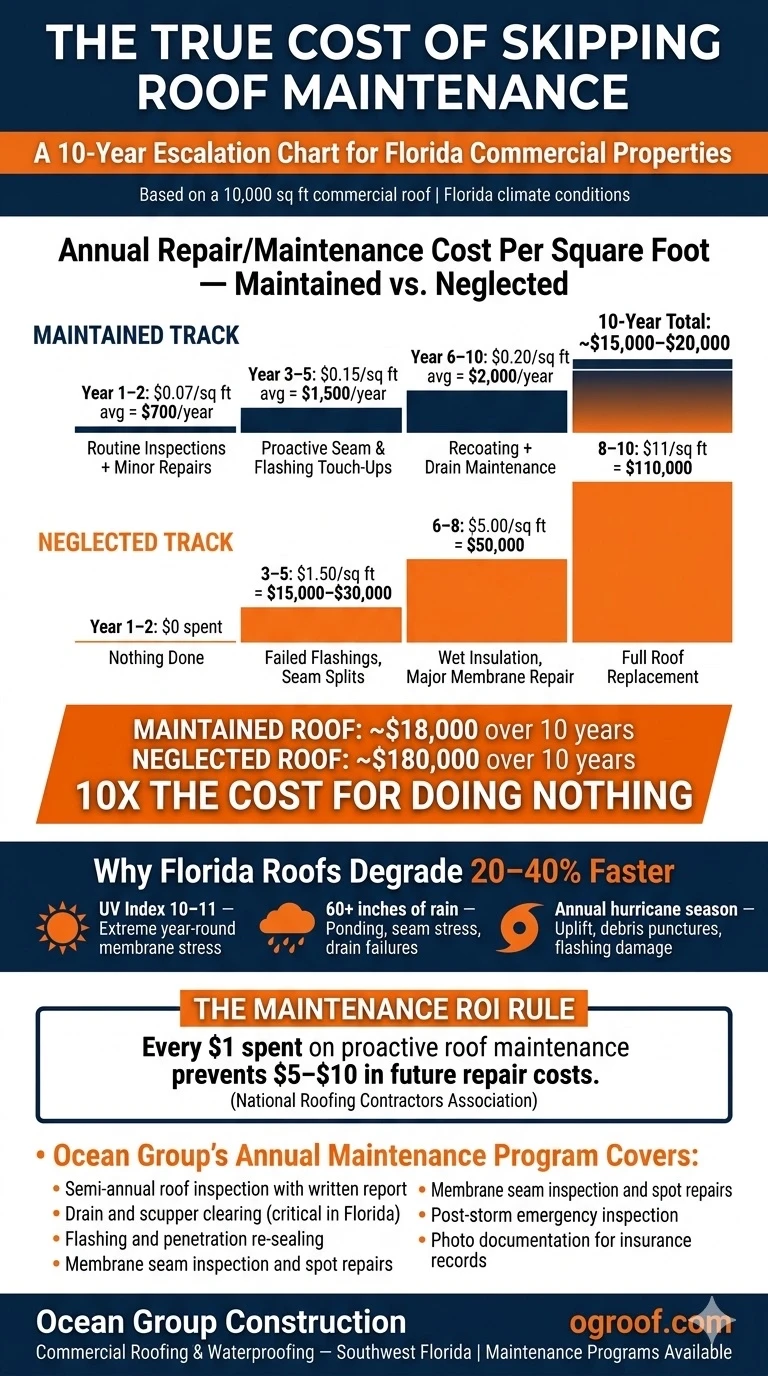
That's not a scare tactic. That's the actual cost difference between a maintained 10,000 sq ft commercial roof in Florida and a neglected one over the same decade. One building owner writes small, predictable checks. The other ignores the roof until the ceiling is staining — a problem documented in detail when you ignore even small commercial roof leaks, the insulation is saturated, and the deck is compromised — and then pays ten times as much to fix it.
This is the math that property managers, building owners, and HOA boards need to see before they decide maintenance is a line item worth cutting.
The Two Tracks: What the Numbers Actually Look Like
On a 10,000 sq ft commercial roof, the cost-per-square-foot trajectory looks like this:
Maintained track:
- Early service years: documented inspections, drain clearing and targeted flashing work as conditions require
- Mid-life planning: seam review, moisture investigation and prioritized repairs based on findings
- Later-life planning: compare targeted repair, restoration and replacement using current field data
- Budget from the roof's actual condition, access and assembly—not a generic allowance.
Neglected track:
- Early service years: no documented baseline and no recurring drainage or detail review
- When leaks appear: reactive investigation with an uncertain moisture footprint
- As moisture spreads: broader insulation, membrane or deck scope may be required
- At capital planning: fewer options and less control over schedule, access and tenant coordination
- Actual costs remain property-specific and cannot be predicted from age alone.
Maintenance does not guarantee a particular outcome, but it gives owners better evidence, earlier choices and a more defensible capital plan.
Why Florida Roofs Degrade 20–40% Faster
The numbers above would be bad anywhere. In Florida, they're worse — because Florida is the harshest roofing climate in the continental United States.
High UV exposure. Sustained sunlight can age membranes, sealants and exposed details. Actual service life depends on the installed assembly, exposure, workmanship, drainage and maintenance history.
60+ inches of rain annually. Florida gets more rainfall than Seattle — and commercial flat roofs catch every drop of it. Even small drainage deficiencies lead to ponding, and ponding accelerates membrane breakdown, seam separation, and eventually insulation saturation.
Hurricane season June through November. Wind uplift, debris punctures, and post-storm water intrusion are not hypothetical risks in Florida. They are annual events. A roof with compromised seams or unsealed penetrations going into hurricane season is a liability waiting to materialize.
These factors make a documented local inspection more useful than a national service-life assumption.
Why Early Documentation Matters
Want to know what this means for your roof?
One call. We'll tell you exactly where you stand.
Call 786-696-4829Small detail failures are generally easier to scope before moisture migrates into insulation, deck or occupied space. That is the practical value of recurring documentation.
Water can travel away from the visible entry point, so an isolated ceiling stain may not describe the full roof-side condition. Investigation and moisture mapping should drive the scope.
What a Real Maintenance Program Looks Like
Our maintenance program for commercial properties isn't a once-a-year drive-by inspection. It's a structured protocol designed to catch problems at the earliest possible stage — when they're cheap.
Semi-annual roof inspections. Spring and fall. Documented with photos, written reports, and GPS-referenced problem areas so you have a historical record. This matters for insurance claims and for tracking degradation over time.
Drain and scupper clearing. Every inspection. Standing water is the enemy. We confirm all drainage pathways are clear and functioning before rainy season and after major storm events.
Flashing re-sealing. Flashings at walls, curbs, and penetrations are the #1 failure point on commercial roofs. We inspect and re-seal any areas showing separation or degradation — before they become leaks.
Seam inspection and targeted repair. For TPO and PVC systems, qualified technicians review suspect seams and determine whether cleaning, welding, sealing or broader investigation is appropriate.
Post-storm inspection. After any named storm or significant wind event, we do a documented damage assessment — both for your records and for potential insurance documentation. This is not optional in Florida.
Photo documentation and reporting. Every visit is documented. You get a written report with photos. This builds a maintenance history that protects you in insurance disputes, extends warranty coverage on some systems, and gives you hard data for capital planning.
The Budget Conversation Building Owners Need to Have
We understand the budget pressure. Maintenance doesn't feel like value the way a new roof does. There's no ribbon-cutting moment. No visible improvement. You're paying to prevent something that hasn't happened yet.
Deferred maintenance does not eliminate risk. It reduces the evidence available to owners and can allow a limited defect to become a broader scope before it is documented.
The building owners and property managers who come to us with the most painful repair bills almost always say the same thing: "I knew I should have had it looked at sooner." The ones who run structured maintenance programs almost never have those conversations — because the problems never compound to that level.
The decision should be evidence-based. To see what a maintenance program can include, our commercial roof cleaning and maintenance guide covers the workflow. If replacement may be necessary, our guide to commercial roof replacement signs explains the conditions to document.