Commercial Roof Lifespan by System Type — Florida Climate Performance Guide
Published March 2026 · Ocean Group Construction
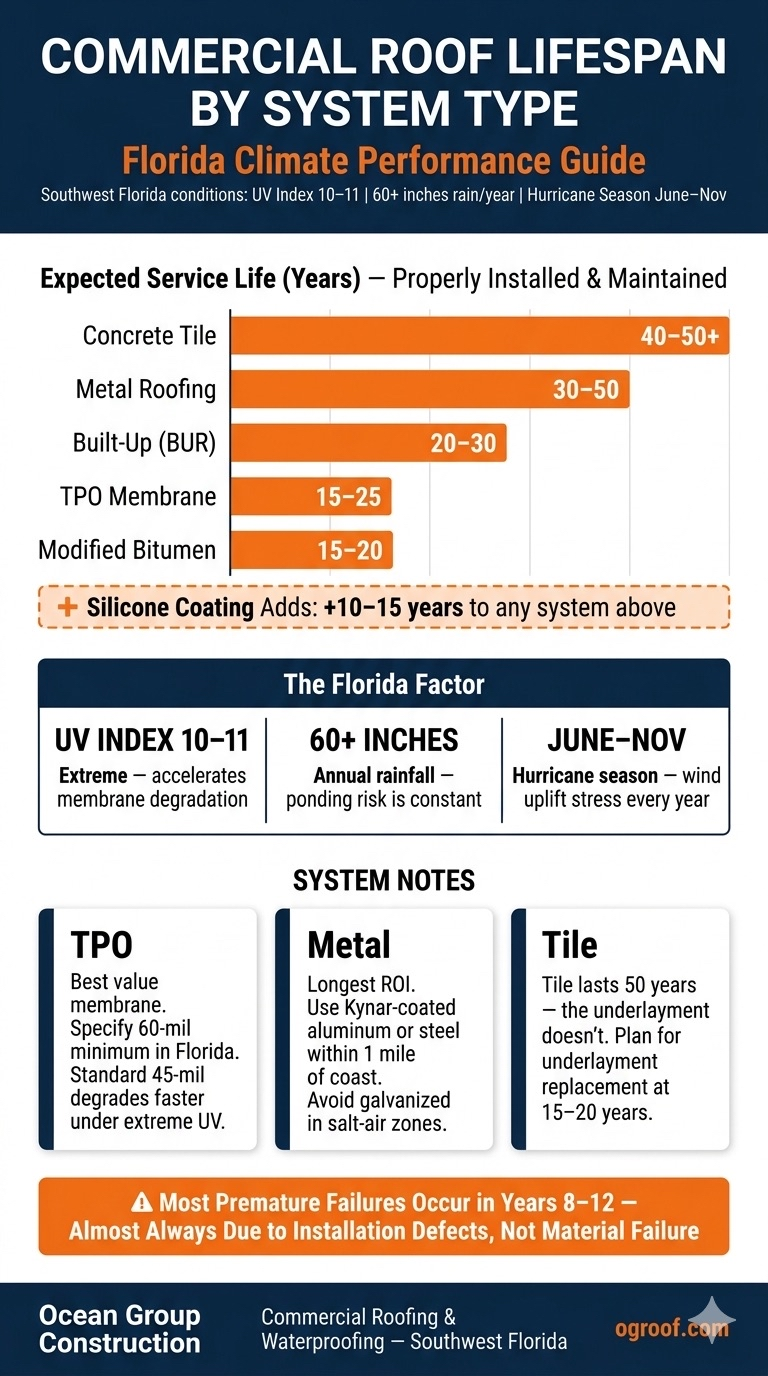
Every system has a number. But that number only holds if the install was right and the climate is accounted for.
One of the most common questions we get from building owners, property managers, and GCs is some version of: "How long is this roof going to last?" It's the right question. It determines your capital reserve schedule, your maintenance budget, and your total cost of ownership.
The answer depends on two things: the system type and the climate it's operating in. In Florida, the climate variable is not minor. UV index 10–11, 60+ inches of annual rainfall, and hurricane season June through November create conditions that accelerate degradation across every roofing system. This guide gives you the real numbers — with the Florida adjustment built in.
System-by-System Lifespan: What to Actually Expect in Florida
Concrete Tile — 40–50+ Years
Concrete tile is the longest-lived commercial roofing system in Florida when properly installed and maintained. The tile itself is essentially indestructible under normal conditions — it handles UV, rain, and hurricane-force wind (when properly fastened) better than any other material.
The Florida caveat: The tile isn't what fails. The underlayment is. In Florida's heat and UV environment, traditional felt underlayment degrades in 15–20 years. The tile can look perfect on the outside while the water-shedding layer beneath it has failed. Any concrete tile system over 15 years old that hasn't had the underlayment inspected or replaced is a risk — regardless of how good the tiles look.
Maintenance priority: Underlayment condition assessment at year 12–15. Don't let the tile's appearance fool you.
Metal Roofing — 30–50 Years
Metal roofing performs exceptionally well in Florida when specified correctly. It handles hurricane-force wind uplift better than low-slope membrane systems, sheds water aggressively, and reflects UV effectively — all of which matters in this climate.
The Florida caveat: Coastal exposure kills unprepared metal. Within one mile of saltwater — gulf or ocean — standard painted steel degrades rapidly from salt air corrosion. The specification requirement is Kynar 500-coated steel or aluminum. Any metal system installed within coastal proximity without that specification is going to fail prematurely. We see this regularly on properties that used the lowest-cost metal option without accounting for exposure zone.
Thermal expansion is the other issue. Florida's daily and seasonal temperature swings create significant movement in metal panels. Fastener patterns, clip systems, and sealant selections all have to account for this or you'll see fastener backout and sealant failure within 7–10 years.
Maintenance priority: Annual fastener inspection and sealant check at all penetrations and ridge caps. Coastal properties every 6 months.
Built-Up Roofing (BUR) — 20–30 Years
BUR — multiple plies of reinforcing fabric embedded in hot asphalt or cold-applied adhesive — has been the workhorse of commercial flat roofing for over a century. It's still a solid system when properly installed, with excellent redundancy: water has to breach multiple plies to get through.
The Florida caveat: Asphalt-based systems soften in extreme heat, and Florida summers regularly push rooftop surface temperatures above 170°F. This can cause asphalt migration in improperly designed systems. BUR also weighs more than membrane systems — relevant for older structures where dead load is a constraint.
A well-maintained BUR system with proper surface coating and regular maintenance can reach and exceed 25 years. Without maintenance, expect 12–15.
TPO (Thermoplastic Polyolefin) — 15–25 Years
TPO has become the dominant commercial flat roofing system in the United States over the past two decades — for good reasons. It's energy-efficient (highly reflective white membrane), heat-weldable at seams for superior watertight performance, and cost-effective to install.
The Florida caveat: TPO specification matters enormously in Florida. The industry produces 45-mil, 60-mil, and 80-mil TPO. In Florida's UV environment, 45-mil should not be specified for new commercial installations. The minimum we recommend is 60-mil; 80-mil for high-abuse applications or projects where longevity is the priority. A 45-mil TPO in Florida UV will show accelerated seam degradation and membrane brittleness within 8–10 years — well short of the expected lifespan.
A properly specified and installed 60-mil or 80-mil TPO system, with annual seam inspections and maintenance, should reach 20–25 years in Florida. Undersized spec, poor installation, or deferred maintenance cuts that in half.
Maintenance priority: Annual seam inspection — every seam, probed. This is non-negotiable for TPO in Florida UV conditions.
Modified Bitumen — 15–20 Years
Modified bitumen (mod bit) is an asphalt-based sheet membrane reinforced with polyester or fiberglass — installed by torch-applied, self-adhered, or cold-process methods. It's a reliable system for low-slope commercial applications with good puncture resistance and decent UV performance when surfaced with granules or reflective coating.
The Florida caveat: Torch-applied mod bit requires a skilled crew. In Florida's heat, torch-down work has to be executed with precision — overtorching causes asphalt bleed and seam adhesion problems that may not become apparent for 3–5 years. Granule loss is also accelerated in Florida UV; plan for coating or recoating at year 8–12 to maintain UV protection.
The Florida Factor: What Every Number Gets Adjusted For
Every lifespan number above assumes the Florida climate. Here's what that means for your planning:
- UV Index 10–11: The highest sustained UV in the continental U.S. oxidizes membranes, bleaches coatings, and breaks down adhesives at roughly 1.5–2x the rate of northern climates.
- 60+ inches annual rainfall: More rainfall than Seattle. Drainage design and maintenance are non-negotiable.
- Hurricane season June–November: Wind uplift, debris impact, and post-storm water intrusion are annual risk events, not rare occurrences.
The Silicone Coating Wildcard: Add 10–15 Years to Any System
Questions about your roof?
Call us. Real contractor, real answers, no sales script.
📞 Call 786-696-4829One factor that changes the lifespan calculation for any existing system: silicone coating. A properly applied silicone roof coating on a structurally sound system extends service life by 10–15 years, adds a seamless waterproof membrane over the existing surface, and delivers significant UV and energy performance benefits.
For building owners approaching the end of a system's service life, coating is frequently the better financial decision over full replacement. We cover the full cost comparison in our silicone coating vs. full replacement article.
The Real Reason Roofs Fail Early: Installation, Not Materials
In our experience, the most premature failures — the roofs that need major repair or replacement in years 8–12 rather than years 20–25 — are almost never material failures. They're installation failures. For a full breakdown of how each system is assembled layer by layer, see our commercial roof system breakdown. And for a broader overview of all the systems available in Florida's climate, our Florida roofing systems guide covers the full field.
Improperly welded TPO seams that don't fully bond. Flashings that were cut short because it was faster. Underlayment that wasn't lapped correctly. ISO boards that weren't staggered and taped. These shortcuts are invisible on day one. They become very visible at year 8 when the seam lets go in a rainstorm.
The specification on the material doesn't matter if the crew doesn't execute it. This is the most important factor in commercial roof lifespan — more important than the system type, more important than the membrane thickness. Who installed it, and did they do it right.