Silicone Roof Coating vs. Full Replacement — The Numbers Don't Lie
Published March 2026 · Ocean Group Construction
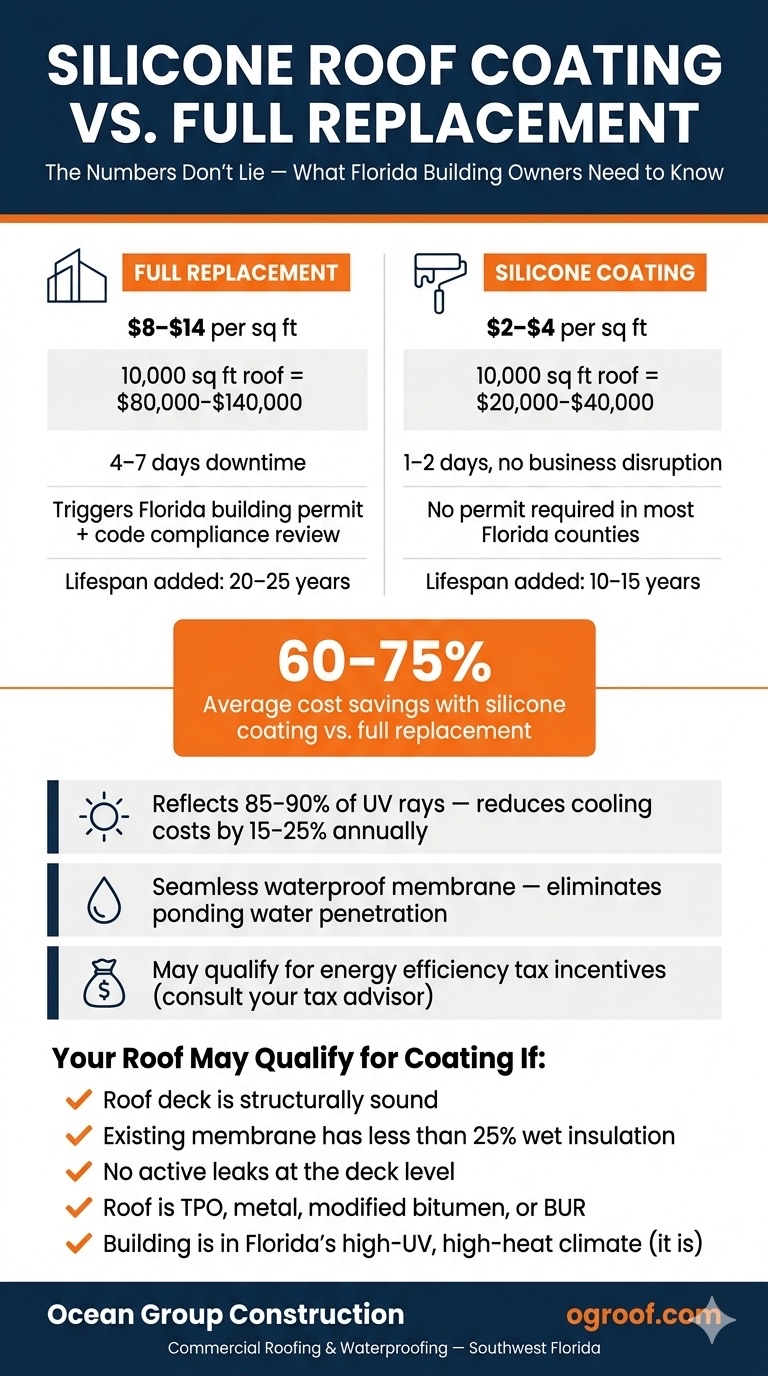
Two options. One costs $120K. One costs $30K. Same building, same result for the next 15 years. Here's how to know which one you need.
If you own or manage a commercial building in Florida and your roof is approaching end-of-life — or you've been told it "needs to be replaced" — there's a question you need answered before you authorize any work: does this roof qualify for a silicone coating, or does it actually need full replacement?
The cost difference is not marginal. For a qualifying roof, choosing coating over replacement represents 60–75% cost savings. For a roof that doesn't qualify, coating is a short-term band-aid on a structural problem. Getting this call right is the most important financial decision you'll make about your building this decade.
The Full Cost Comparison
| Factor | Full Replacement | Silicone Coating |
|---|---|---|
| Cost per sq ft | $8–$14/sq ft | $2–$4/sq ft |
| 10,000 sq ft cost | $80,000–$140,000 | $20,000–$40,000 |
| Downtime / disruption | 4–7 days, significant disruption | 1–2 days, minimal disruption |
| Permits required | Yes — triggers full code review | No permit in most FL counties |
| Service life added | 20–25 years | 10–15 years |
| Cost savings | — | 60–75% vs replacement |
The math is not close. If your roof qualifies for a coating, it's not a marginal decision. It's the obvious one.
What Silicone Coating Actually Does to Your Roof
Understanding the value of silicone coating requires understanding what you're actually buying — not just in cost terms, but in performance terms.
UV reflection. A properly applied silicone coating reflects 85–90% of UV radiation. In Florida — UV index 10–11, year-round — this is not a minor benefit. It's the primary factor in membrane longevity. The membrane underneath stops absorbing UV. Degradation slows dramatically. Heat-related expansion and contraction cycles decrease. This alone extends membrane life significantly.
Cooling cost reduction. That same reflectivity that protects your roof reduces heat transfer into your building. Most commercial building owners see 15–25% reduction in cooling costs after silicone coating application. In a Florida commercial building where HVAC runs 10–11 months a year, that's real money, year after year.
Seamless waterproof membrane. Silicone is spray-applied as a liquid and cures to a seamless, fully adhered membrane over the entire roof surface — including over existing seams, flashings, and penetrations. You're adding a new waterproof layer with zero seams. This is a meaningful upgrade in waterproofing performance, particularly for aging TPO or mod bit systems where seam integrity is the primary failure concern.
No disruption to building operations. Full replacement means a crew removing an entire roof system, disposing of it, and installing a new one — typically over 4–7 days with significant noise, debris, and interruption. Coating application typically completes in 1–2 days with minimal disruption. For occupied commercial properties, this matters.
Energy tax incentives. Silicone roof coatings may qualify for federal energy efficiency tax incentives under Section 179D (commercial buildings) and in some cases state-level incentives for energy-efficient building upgrades. Talk to your tax advisor — the energy savings on a qualifying building may be partially recoverable.
The Qualification Checklist: Does Your Roof Qualify?
Questions about your roof?
Call us. Real contractor, real answers, no sales script.
📞 Call 786-696-4829Silicone coating is not the right answer for every roof. The qualification assessment is the critical first step. Here's what we look for:
✅ Structurally sound roof deck. The deck must be intact and without compromise. Core cuts assess whether the deck is dry and structurally adequate. A compromised deck cannot be coated — it must be replaced or repaired first.
✅ Less than 25% wet insulation. We use infrared scanning and core cuts to determine how much of the insulation layer has been saturated by water intrusion. Under 25% wet insulation, we can remove and replace the affected sections and coat the remainder. Over 25%, the economics shift toward full replacement.
✅ No active deck leaks. Any active water intrusion pathways must be identified and remediated before coating. Coating over an active leak seals moisture in — it doesn't solve the problem, it amplifies it.
✅ Compatible substrate. Silicone adheres excellently to TPO, metal, modified bitumen, and BUR. Some substrates require a primer. The assessment includes confirming compatibility and adhesion conditions.
✅ Florida high-UV climate. This one is automatic for any Florida property. The climate benefit from silicone's UV reflectivity is maximized in high-UV environments — and Florida is the highest-UV commercial real estate market in the country.
When Full Replacement Is the Right Call
We don't oversell coatings. When a roof needs to come off, we say so. The clear cases for full replacement:
- Deck compromise — wet, delaminated, or structurally inadequate decking
- Wet insulation exceeding 25% of the roof area
- Multiple large active leaks that indicate systemic failure rather than isolated issues
- A system already at or beyond the end of its rated service life with deferred maintenance
- A building undergoing renovation where roof access requirements make replacement practical
In those cases, replacement is not just the right answer — it's the only answer. Coating a failing system is false economy.
How to Know Which Category You're In
There's only one way to know whether your roof qualifies for coating: a professional assessment that includes infrared scanning, core cuts, and a written evaluation of deck condition, insulation saturation, and substrate compatibility.
That assessment takes a few hours. The findings are documented with photos and measurements. At the end of it, you have clear data — not a sales pitch — on whether you're in the $30K category or the $120K category. For a detailed walkthrough of the coating vs. replacement decision framework — including the core cut process — see our reroofing vs. coating restoration guide. If you're building the ROI case for a full replacement, our commercial roof replacement ROI analysis covers the full five-category payback calculation. And to understand everything silicone coatings actually deliver, our silicone roof coating benefits breakdown covers performance, energy savings, and long-term recoatability.
For most building owners, that assessment is the best two hours of ROI they'll spend this year.