When Waterproofing Fails — The Cascading Damage Timeline
Published March 2026 · Ocean Group Construction
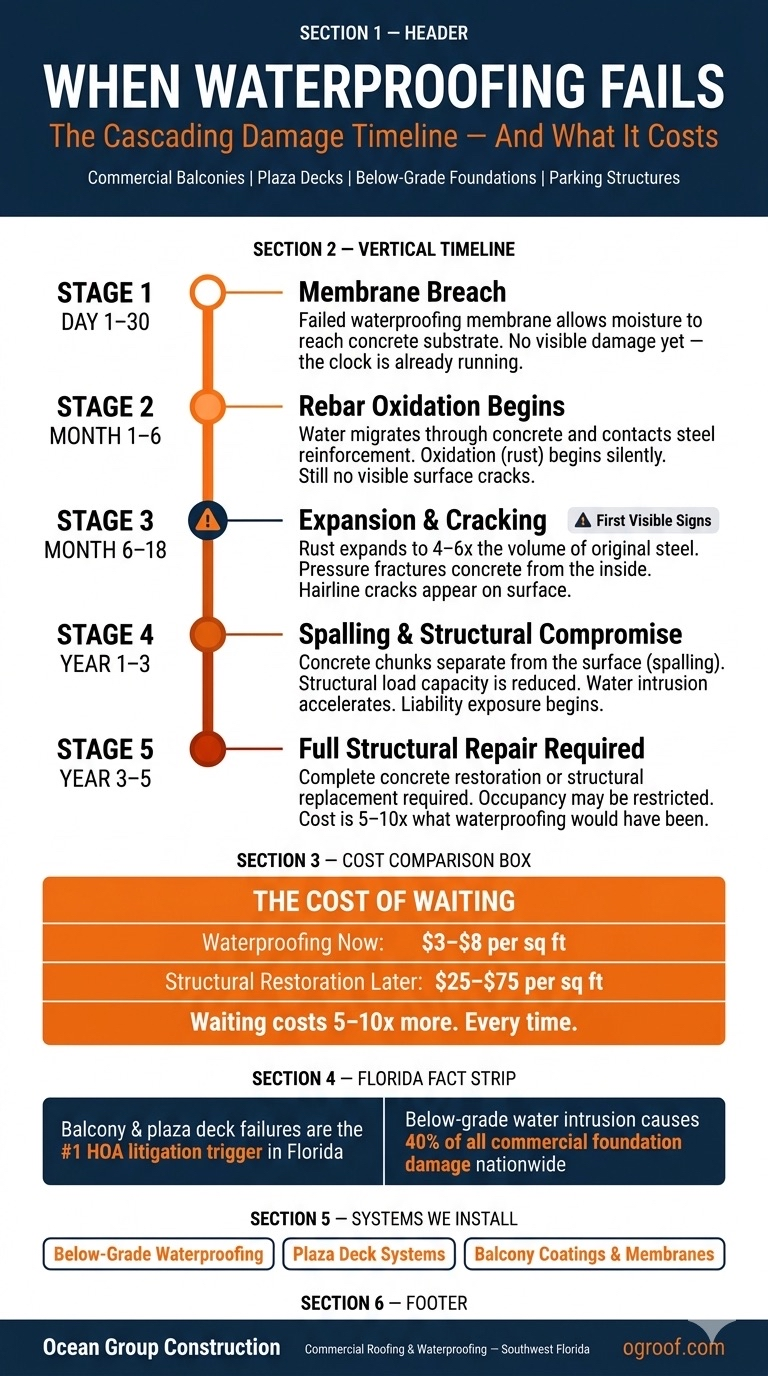
By the time you see the cracks, the damage has been compounding for months. Here's the timeline nobody shows you.
The most dangerous thing about waterproofing failure is how long it's invisible. There's no alarm, no obvious leak, no ceiling stain to trigger urgency. The water gets in. The concrete absorbs it. The rebar starts to rust. And by the time any of this becomes visible — the hairline crack, the spall, the surface stain — you're already in Stage 3 of a 5-stage failure cascade that started long before anyone noticed.
Understanding this timeline is the difference between a $3–$8 per square foot waterproofing repair and a $25–$75 per square foot structural restoration. That's a 5–10x cost multiplier for waiting.
Stage 1: Membrane Breach (Days 1–30)
Waterproofing membrane failure begins as a micro-event — a pinhole crack at a stress point, a seam separation from thermal cycling, a joint that wasn't properly detailed during installation. Water finds it immediately. Concrete is porous; it doesn't stop water, it absorbs it.
At this stage, the damage is invisible and the repair is cheap. A properly installed waterproofing system with regular inspection catches this in the first annual walkthrough. A membrane breach at this stage costs $500–$2,000 to address.
Most of these breaches go undetected. No one is on the balcony deck with a probe. No one is inspecting the below-grade wall on a quarterly basis. The water keeps moving.
Stage 2: Rebar Oxidation (Months 1–6)
Concrete is alkaline by nature, which normally passivates the steel rebar embedded inside it. But sustained moisture contact breaks down that alkaline protection layer and oxygen reaches the steel. Oxidation begins.
Rust takes up significantly more volume than steel — expansion ratios of 3:1 to 6:1 are common. That expansion is happening inside the concrete, where you can't see it, creating internal pressure that the concrete must eventually relieve.
Still no visible symptoms. Still no alarm. The first opportunity to intervene affordably — the membrane breach stage — has passed. We're now building toward something structural.
Stage 3: Expansion and Cracking (Months 6–18) — First Visible Signs
This is when you finally see something. Hairline cracks appear at the concrete surface — often in a pattern that follows the rebar grid beneath. Surface staining from iron oxide (rust bleeding through) may appear. Efflorescence — white mineral deposits — may appear at cracks.
This is the stage most building owners bring us in. The cracks are visible, there's concern, and the question is whether it's cosmetic or structural. At this stage, the answer is: it's structural in progress. The rebar has been oxidizing for months. The concrete integrity is already compromised in the affected area.
Repair at Stage 3 is still manageable — crack injection, localized section repair, membrane replacement — but costs have now climbed to $8–$15 per square foot depending on extent. The window for the cheapest intervention has closed.
Stage 4: Spalling and Structural Compromise (Years 1–3)
Concrete spalling is the inevitable result of unchecked rebar oxidation. The expanding rust exerts enough internal pressure to delaminate the concrete surface — chunks break away, exposing the corroded rebar directly to the environment. The structural cross-section of the affected members is now actively diminishing.
This is where liability becomes acute. Spalling concrete on a balcony, parking structure, or plaza deck is a safety hazard. In Florida, balcony and plaza deck failures have become the #1 litigation trigger for HOAs — a direct result of deferred waterproofing maintenance cascading to this stage.
Repair at Stage 4 requires concrete saw-cutting, removal of all delaminated material, cleaning and treating the exposed rebar, applying corrosion inhibitors, and patching with engineered repair mortars. Then the surface waterproofing system must be replaced over the repaired area. You're now at $15–$35 per square foot and rising.
Stage 5: Full Structural Repair Required (Years 3–5)
At Stage 5, the structural integrity of the affected element is in question. Load-bearing capacity may be compromised. The repair is no longer a roofing or waterproofing project — it's a structural engineering project that involves a licensed structural engineer, core samples, load calculations, and potentially temporary shoring.
Costs at this stage: $25–$75 per square foot depending on depth of structural compromise. On a 5,000 sq ft plaza deck or parking structure, that's $125,000 to $375,000 — for a problem that started as a $1,500 membrane repair.
Below-grade water intrusion follows the same cascade but is even more insidious. Forty percent of all commercial foundation damage is attributed to below-grade water intrusion — water that migrates through foundation walls, under slabs, and into below-grade spaces over years of unchecked infiltration.
The Cost-of-Waiting Math
| Intervention Stage | Timeframe | Cost per Sq Ft |
|---|---|---|
| Membrane breach (proactive) | Days 1–30 | $3–$8 |
| Cracking (reactive) | Months 6–18 | $8–$15 |
| Spalling (structural) | Years 1–3 | $15–$35 |
| Full structural restoration | Years 3–5 | $25–$75 |
What Ocean Group Installs and Inspects
Our waterproofing work spans the full range of commercial applications where this failure cascade occurs:
Below-grade waterproofing. Foundation walls, elevator pits, below-grade mechanical rooms, parking structures. We install positive-side and negative-side systems depending on access and exposure conditions, with drainage composite layers and protection board where required.
Plaza deck systems. Occupied and non-occupied decks over structural concrete — hot-applied modified bitumen, cold-applied liquid membranes, and sheet membrane systems with proper slope-to-drain and protection layers. Plaza decks are one of the most technically demanding waterproofing applications, and one of the most common sources of catastrophic failure when installed without the right expertise.
Balcony coatings and membranes. HOA and condo balconies throughout Southwest Florida. We install traffic-bearing membranes, deck coatings, and drainage systems that meet Florida building code requirements and stand up to the thermal cycling and UV exposure of the Florida climate.
If your property has a plaza deck, parking structure, balconies, or below-grade spaces — and you don't have a documented waterproofing inspection on file from the last 12 months — you are somewhere on this timeline. The only question is where. To understand how to properly waterproof a commercial roof before failure occurs, our guide to commercial roof waterproofing covers every layer and detail from membrane to drainage. On roof decks specifically, the cascade of damage from ignored leaks mirrors what we outline in our guide on why you should never ignore commercial roof leaks — and the financial math in our true cost of skipping roof maintenance analysis shows exactly how deferral compounds cost over time.