Flat Roof Drainage: Why It Matters More Than You Think
Published March 2026 · Ocean Group Construction
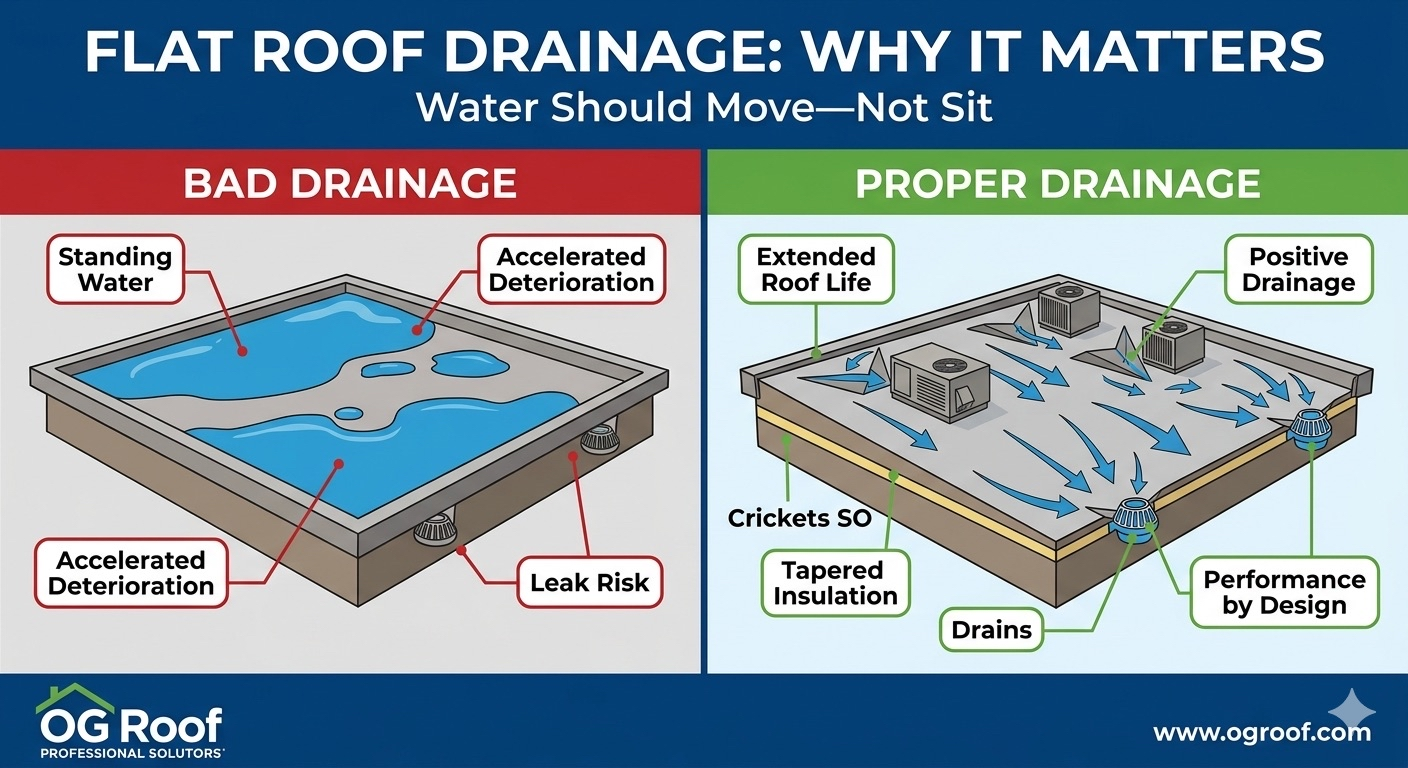
Here's what I see on roofs every single week in Southwest Florida: buildings where the owner paid for a decent roof system, installed by a contractor who cut one corner — drainage. And now, three years later, they're looking at a roof that should have another 17 years of life but is already showing seam separation, membrane blistering, and wet insulation.
That one corner cost them a decade of roof life. Here's why.
What "Flat" Actually Means — And the Problem With It
Commercial roofs are called "flat," but they're not supposed to be truly flat. Building codes require a minimum slope of 1/4 inch per foot to allow water to drain. The problem is that structural deflection, improper installation, and settling can create low spots where water collects — what the industry calls ponding water.
The definition of ponding water: any water that remains on the roof surface 48 hours after rain stops. In Florida, where we get 54+ inches of rain annually and afternoon thunderstorms hit almost daily from June through September, a roof that ponds water is a roof that's under constant stress.
What Standing Water Actually Does to a Roof
This is what nobody tells building owners. Standing water doesn't just sit there — it works. Every additional inch of water adds about 5 pounds per square foot of dead load that wasn't accounted for in your structural design. A 100-square-foot pond at 2 inches deep is 500 extra pounds on your structure.
But the structural load is the least of your problems. Here's what ponding water does to the roof system itself:
- Accelerated UV degradation: Water acts as a lens. In Florida's intense sunlight, standing water concentrates UV radiation and heat directly onto the membrane surface, degrading the material 3-5x faster than normal exposure.
- Seam stress: As water evaporates, it leaves behind mineral deposits that work into seam edges. Combined with the weight of the water pulling on the membrane, seams that should last 20 years start showing stress in 5-7.
- Insulation saturation: When ponding eventually finds a pathway through the membrane — and it will — it saturates your polyiso insulation. Wet insulation has essentially zero R-value and must be removed and replaced. A $15,000 drainage fix becomes a $60,000 tear-off and re-insulation.
- Biological growth: Standing water grows algae and mold. That biological growth etches into the membrane surface, particularly TPO, reducing its reflectivity and accelerating deterioration. It also creates the kind of staining that becomes a permanent maintenance headache.
How Proper Drainage Works: The Tools We Use
Fixing a drainage problem isn't complicated — it's just engineering that has to be designed in from the start, or addressed deliberately in a re-roofing project. Here's what actually creates positive drainage:
Tapered Insulation Systems
Tapered polyiso insulation is the right answer for most flat commercial roofs. Instead of flat panels, tapered ISO is cut at angles — typically starting at 1/4" per foot and increasing toward drains — so the insulation itself creates the slope. The structural deck stays flat (as-built), and the slope lives in the insulation layer where it belongs.
A proper tapered ISO layout is engineered, not guessed. We use slope diagrams that map every panel, every direction of flow, and every drain location before a single piece of insulation hits the deck. When it's done right, water moves. When it's not done right, you get what I described above.
Crickets and Saddles
Anywhere water would naturally collect behind an HVAC unit, a parapet wall, or a piece of equipment, you build a cricket — a triangular tapered section that redirects water around the obstruction. This is detail work. It takes an extra hour per cricket. Contractors who skip it save maybe $200 in labor and create a $10,000 leak in year four.
Drain Placement and Sizing
Most commercial buildings have interior drains — roof drains that flow through the building structure. The placement of those drains determines everything about how the roof drains. They need to be at the low points (obviously), but they also need to be sized for the roof area they serve. Florida's rainfall intensity — we regularly see 3-4 inches per hour during severe thunderstorms — means undersized drains create emergency ponding conditions even on roofs with perfect slope.
Per the Florida Building Code, the minimum drain capacity calculation has to account for 100-year storm rainfall intensity for your county. Don't skip this math.
Overflow Drains and Scuppers
Primary drains can clog. Code requires secondary drainage — overflow drains or scuppers — positioned 2 inches above the primary drain elevation. When primary drains clog during a major storm event (which happens), overflow drainage is what prevents catastrophic ponding and potential structural failure. If your building doesn't have it, that's a code deficiency that needs to be corrected.
The Florida Factor
Drainage matters everywhere. It matters more in Florida than almost anywhere else in the country, and here's why: we don't get rain evenly distributed throughout the year. We get intense wet season rain from June through November — often 6+ inches in a single storm event — followed by dry season periods where the roof dries out completely.
That wet-dry cycling is brutal on a poorly drained roof. Water intrudes during wet season, the insulation saturates, dry season comes and the system tries to dry out — but the membrane traps moisture inside. That moisture has nowhere to go except to push up through the membrane as blistering, or out through seam edges as delamination.
Add in Florida's hurricane risk — a Category 3 storm can drop 10-15 inches of rain in 24 hours — and you see why drainage isn't optional. It's survival.
What It Costs to Fix vs. What It Costs to Do Right
Installing a full tapered ISO drainage system on a 20,000 sq ft commercial roof adds roughly $0.75-$1.25 per square foot to the project cost compared to flat insulation. That's $15,000-$25,000 on a mid-sized commercial roof.
Replacing wet insulation, repairing seams, and re-roofing a 20,000 sq ft roof that failed prematurely due to drainage problems runs $80,000-$140,000 — and that's not counting the interior damage from the leaks that got you there.
The math isn't complicated.
What to Do If You Already Have a Drainage Problem
If your existing roof has ponding areas, the options are: (1) retrofit tapered insulation overlayment — a roof maintenance specialist can assess which approach is right for you to the existing system, (2) install crickets and saddles to redirect flow, or (3) re-slope specific problem areas with a fill-and-drain solution. Which approach makes sense depends on your existing system's condition, the severity of the drainage issue, and your timeline.
Don't wait on this. Every rainstorm that ponds on your roof is shortening its life — and our guide on how rain damages flat roofs covers the full timeline of deterioration. Get it documented and get a plan with a professional roof inspection. For a complete picture of the maintenance program that keeps drainage systems functioning, see our commercial roof cleaning and maintenance guide.
Read more about where commercial roofs actually fail and what separates a good installation from a bad one. To understand the financial impact of skipping regular drainage maintenance, our true cost of skipping roof maintenance analysis shows how drainage-related neglect compounds into major capital expenditures.
📞 786-696-4829 · Schedule a Roof Inspection
Active commercial roof leak right now? Go to commercial leak repair →