The Weakest Points on a Commercial Roof — And How to Protect Them
Published March 2026 · Ocean Group Construction
If you manage a commercial building in Florida, your maintenance strategy should give close attention to transition points — for the full breakdown, see where commercial roofs actually fail. Penetrations, edges, seams, flashings, and other detail areas are commonly observed leak sources, while the field membrane is not always the first point of failure. Here are six vulnerable areas to inspect and what you can do about each one.
1. Pipe Penetrations and Equipment Curbs
Every pipe, conduit, vent, and HVAC unit that passes through your roof creates a hole in an otherwise continuous waterproof membrane. Each penetration requires a flashing detail — a boot, collar, or pitch pocket that seals the membrane to the penetrating object. These details are the most common failure point on commercial roofs because they involve multiple materials meeting at different angles, all subject to UV degradation, thermal movement, and physical abuse from maintenance traffic.
Prevention: Use prefabricated pitch pockets with pourable sealer, replace rubber boots every 8-10 years, and inspect all penetrations during annual maintenance.
2. Membrane Seams
Single-ply roofing systems (TPO, PVC, EPDM) are installed in sheets that overlap and are joined by heat welding or adhesive. Every seam is a potential entry point for water. Heat-welded TPO and PVC seams are extremely reliable when properly made — the weld is stronger than the membrane itself. But if the welding temperature was wrong, the sheets were contaminated, or the weld wasn't tested, you have a ticking time bomb.
Prevention: Require seam probe testing during installation, include seam inspections in annual maintenance, and address any fishmouthing or edge lifting immediately.
3. Roof Edge and Coping
Need a commercial roofing assessment?
We answer phones — not contact forms. Talk to a contractor who's been on a roof this week.
Call 786-696-4829The perimeter of the roof is where the highest wind pressures occur — typically 2-3x the pressure at the center. Edge metal, coping caps, and gravel stops must be mechanically secured to resist these forces. When edge details fail in a wind event, they become the entry point for progressive membrane peeling.
Prevention: Ensure edge metal meets ANSI/SPRI ES-1 standards for your wind zone. Verify continuous cleat attachment. Inspect after every significant wind event.
4. Drain and Scupper Details
Roof drains and scuppers are designed to remove water — but their flashing details are also vulnerable points. Drain bowls that have separated from the membrane, scupper boxes with failed sealant, and overflow drains with cracked collars are common sources of leaks that get misdiagnosed as "the roof is leaking" when really "the drain detail is leaking."
Prevention: Clean drain baskets monthly during wet season, inspect drain-to-membrane connections annually, and never allow ponding water to touch drain flanges for extended periods.
5. Wall Flashings and Counterflashings
Where the roof meets a wall — whether it's a parapet, a penthouse, or an adjacent taller building — the base flashing and counterflashing must work together to prevent water from entering behind the membrane. In Florida, the #1 failure mode here is sealant degradation at the counterflashing reglet. UV and thermal cycling destroy sealant in 5-7 years, and once it fails, water runs behind the flashing and into the building.
Prevention: Replace reglet sealant every 5 years proactively. Ensure base flashing extends a minimum of 8 inches up the wall. Inspect during every maintenance visit.
6. HVAC Equipment Areas
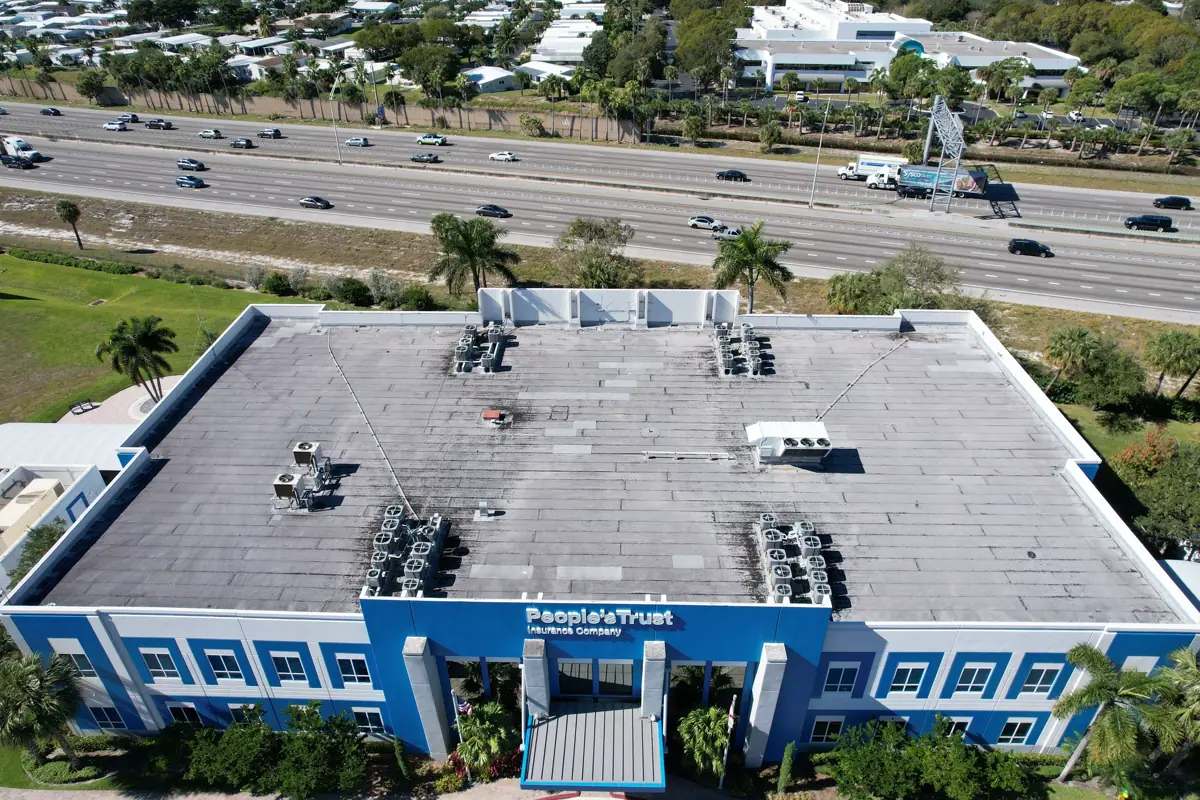
Rooftop HVAC units create a concentration of penetrations, condensate drainage, refrigerant lines, and electrical conduits in a small area — and they attract maintenance foot traffic that damages the surrounding membrane. Many commercial roof leaks near HVAC units aren't roof failures — they're damage from technicians standing on membrane, dropping tools, and dragging equipment across the roof surface.
Prevention: Install walkway pads from the roof access point to all equipment. Use equipment support rails that distribute loads. Brief HVAC contractors on roof protection requirements before they start work.
The Bottom Line
Your roof's field membrane is probably fine. Your transitions, penetrations, and edge details are where the money goes — both in maintenance and in leak repair. Documented inspections can identify transition, penetration, drainage, and edge-detail problems before the failure scope expands. To see how these weak points translate into actual installation decisions, our guide on what separates a good commercial roof installation from a bad one shows how detail work is done right vs. cut short. And because drainage failures are one of the most common weak points, our flat roof drainage guide explains how tapered insulation and proper drain design protect these transitions long-term.